40-Hour Medical Interpreter Training

Online 40-Hour Medical Interpreter Training​
$735

No questions asked 14-Day Money-Back Guarantee

SPANISH

Pay in full or in easy installments with 

klarna

What’s Included

Get Started as a Medical Interpreter Today!

rated on trustpilot

Rated 4.7/5 (1.3k reviews) on Trustpilot

Accredited and Approved By

CCHI approved medical interpreter training
NBCMI approved Medical Interpreter Training​

Our most popular medical interpreter course offers 40 hours of expert-led training designed to prepare you for success in medical interpreting. Study on your schedule and gain the knowledge you need to work professionally in healthcare settings. Our accredited course fulfills the 40-hour training prerequisite required by NBCMI and CCHI for those seeking national certification.

This 40-hour online training is available in 20 languages and includes a final oral exam in the target language and in English. Weekly live group interpretation coaching is led by a professional interpreter in the target language.


40-Hour Medical Interpreter Training

Online 40-Hour Medical Interpreter Training​
$735

No questions asked 14-Day Money-Back Guarantee

SPANISH

Pay in full or in easy installments with

klarna

WHAT'S INCLUDED

Trained Medical Interpreters are in Demand

As a bilingual individual, you’ve got a marketable skill that could lead to a rewarding new career helping others through medical interpretation. Healthcare is a growing field and the potential to find a great job is very real.

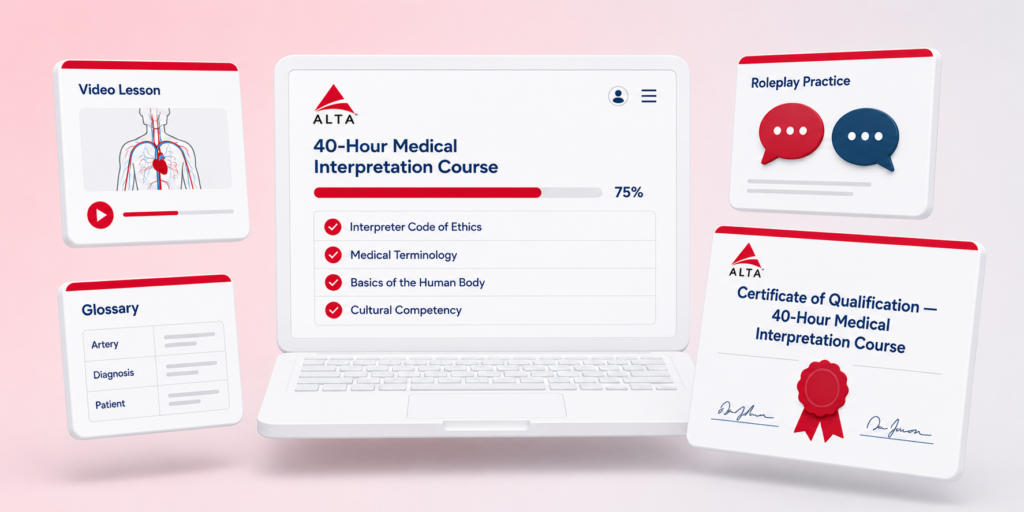
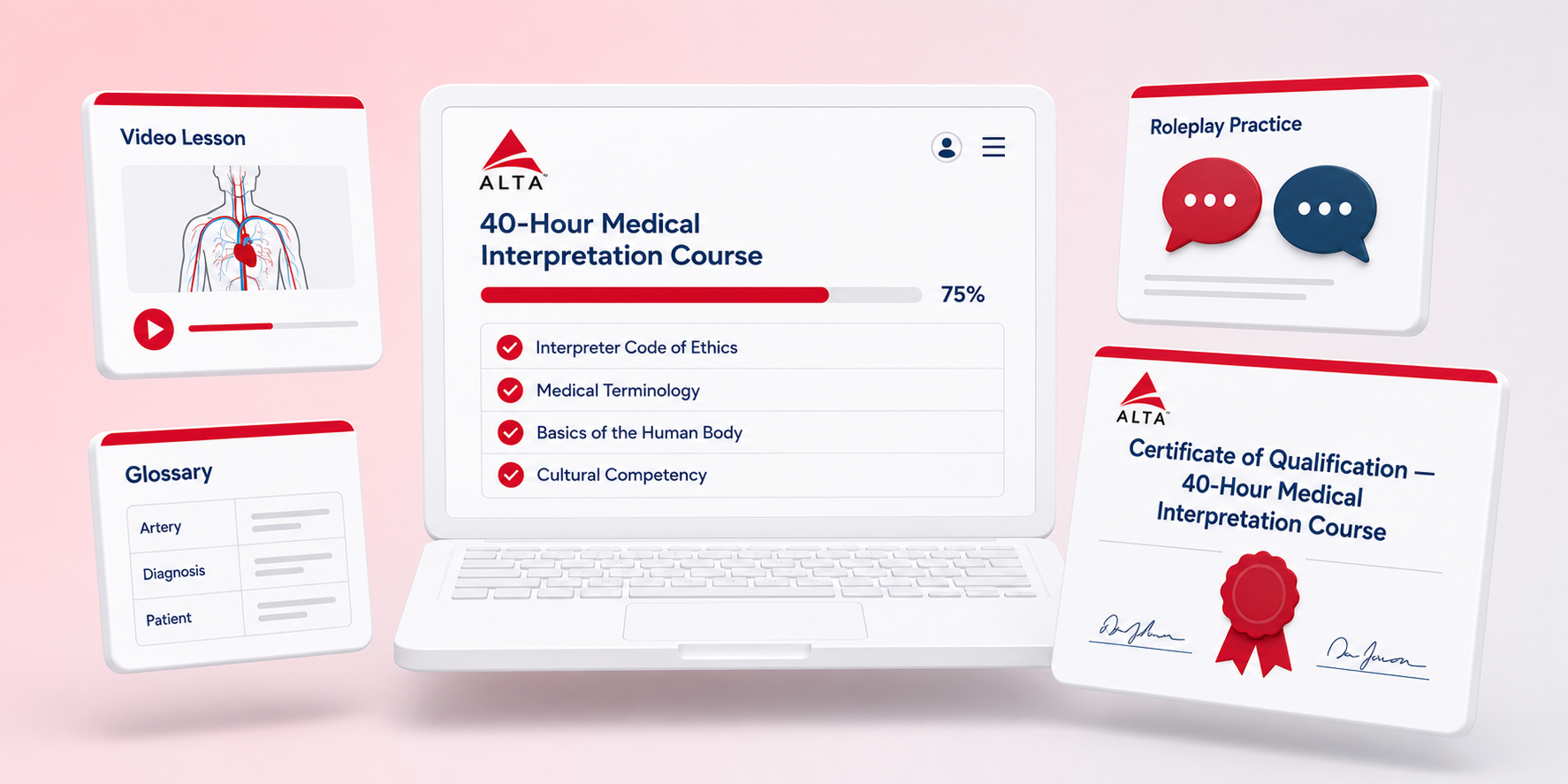
Our 40-hour interpreter training course teaches you everything you need to know to get started as a medical interpreter, like the interpreter code of ethics and standards of practice, the basics of the human body systems, medical terminology, and more.

Meet Your Instructors for Breaking Boundaries in Healthcare 2.0

Add Your Name To Our Growing List Of Nationally Certified ALTA Graduates!
ALTA Language Services is a great partner if you are serious about becoming a certified healthcare or medical interpreter. I completed their 40-hour training course in February 2024, which gave me a solid foundation in U.S. healthcare, medical terminology, and many skills. Just three months later, I passed the rigorous and comprehensive exams by Certification Commission for Healthcare Interpreters (CCHI) becoming CHI. Exactly one year after my ALTA diploma, I was hired full-time as a Senior Medical Language Interpreter at University of Texas Medical Branch (UTMB Health). I recently used ALTA again to prepare for the National Board of Certification for Medical Interpreters (NBCMI) oral exam, which I also passed and now I'm dual certified. The help from ALTA's team was outstanding, clear rubrics, personalized feedback, and great coaching. I felt supported every step of the way. I 100% recommend ALTA's training and prep courses to anyone who wants to go from dream to professional reality. Thank you from Houston, Texas!

I took a medical interpreting course with ALTA over a decade ago, and when I recently needed documentation from that training, their team went above and beyond to assist me. From the customer service reps who promptly answered my calls to the Director of Client Services, Stephanie, everyone was incredibly attentive and dedicated to client satisfaction. Their commitment to supporting students—even years later—truly sets them apart. I highly recommend ALTA for anyone seeking a medical interpreting course. This is an organization that genuinely cares about your success!

I really enjoyed my learning experience with Alta. It was definitely worth the money. Since there are no in-person classes bc of the pandemic, the virtual live-sessions were invaluable for consistent practice with professional medical interpreters still working in the field. Kate and Stephanie with great instructors and always made the atmosphere of each live-session fun and open to ask as many questions as you need. I also loved that if you were not able to attend a live session, you could watch the recording for free. Although I dealt with Stephanie and Kate the most as I attended as many live sessions I possibly could, any time I needed to call or email Alta, I was always met with professionalism and my concerns were handled immediately. Even when there was a hiccup with the processing of my Oral Exam, Stephanie went ABOVE AND BEYOND to get things worked out immediately! I'm so very grateful to her for caring so much! If you are wondering which course you should choose, I recommend Alta 100%!

I have completed and passed the 40 hour medical interpreter training by Alta lang services and let me tell you it is conducted very professionally. The instructors are amazing. The lectures are so beneficial. If you want to be a professional level interpreter sign up for Alta lang. you can't beat the price and payment plan. It's simply the best. Every time I contacted Service. They had a great attitude. Stephanie was exceptionally helpful when she contacted me about a question that I had regarding what I need to do next to prepare for National Certification.

They care that you succeed. I took the Alta 40 hr course and am now taking the National exam prep for Spanish with them. Very informative videos, role play book, and great interpreting tips provided. Would definitely recommend!

I took the 40h Medical interpreter training with ALTA, and I couldn't be happier with this course. Instructors were so professional and helpful, the material was organized and comprehensive, and I learned a lot and developed. I highly recommend ALTA's 40h course.

I just successfully finished ALTA's 40-hr. medical interpretation course as well as the two exams. It was an extraordinary learning experience and the friendliness, responsiveness and professionalism of all their staff and instructors made all the difference. Kudos to ALTA!

I definitely recommend the course. I did the online course and Stephanie (instructor) is amazing! I wish I would have taken advantage of more office hours (live course review, Q&A held 2x week). Each one I participated in was very valuable to my progress and education. The course is well structured and ALTA is very responsive to your needs. The oral exam is challenging but as long as you do your course work and use the materials provided, you will succeed. I feel that it is a great stepping stone in preparation for the CCHI exam. Choosing ALTA for your interpretation training is a great choice!

Propel Your Career with Our Interpreter Training

When you finish the course, you’ll receive a Certificate of Qualification you can use to find work right away.

Bonus: Your certificate also fulfills 3 of the requirements for applying to take the NBCMI or CCHI exams: it serves as proof of your initial interpreter training AND as proof of language proficiency for both English and your target language!

Meet Your Instructors for Breaking Boundaries in Healthcare 2.0

Is Our interpreter training right for you?

The 40-Hour Online Course is perfect for you if:​

Introducing: Breaking Boundaries In Healthcare

The 40-Hour Medical Interpreter Training From ALTA Language Services

This course guides you step-by-step through everything you need to know to become a qualified medical interpreter and apply for jobs with agencies all over the world.

You’ll learn best practices for professional interpretation, practice and develop your oral interpretation skills with our teachers during optional weekly live classes, and have access to our library of digital materials.

Complete the course online at your own pace. You can go through the lessons and pass your tests in just a few weeks if you want. Or complete the lessons over time to make it fit your busy schedule.

Live session benefits: Optional live Zoom sessions let you practice speaking in real time, receive personalized feedback, ask questions, and clarify pronunciation or grammar.

Your Course Materials:

Learn everything you need to know to work as a medical interpreter:

Corporate Interpreter Training

Want to Train Your Team

Empower your bilingual staff with professional interpreter skills- explore our specialized interpreter training program and transform communication within your organization.
Language Includes

What does my language include?

Choose your language below to see what is included with your course:

    Earn Your Certificate of Qualification From Home!

    You’ll take 2 exams to complete our 40-hour course:

    Written Exam

    You’ll take your written exam online in English. Test questions are made up entirely of true/false, multiple-choice, and fill-in-the-blank questions. (No essays!) This exam will test your theoretical knowledge of medical interpretation. Questions cover Interpreter Ethics, best practices, legislation related to language access, medical information, and cultural competency.

    Oral Exam

    Your oral exam is conducted over the phone or via a video connection. There will be 2 evaluators, one playing the part of a doctor speaking English; the other playing the part of a patient speaking in your target language. Your test is an interpretation between the two of them.


    Try it Risk-Free with Our 14-Day Money-Back Guarantee

    ALTA is an employee-owned company, so each one of us is personally invested in your success. We’ve put our heart and soul into this program and we’ve seen it help hundreds of students find fulfilling, well-paying jobs in the healthcare industry. If you dedicate yourself to the program, it works. We know that because our students tell us it’s true…and they have the results to prove it.

    We want to see you grow personally and professionally to meet your goal of being a professional medical interpreter. But if our course isn’t right for you for any reason, just ask for a refund within 14 days and we’ll give you your money back, guaranteed.*

    *If you request a refund you will not be eligible to receive a Certificate of Qualification.

    FAQ

    Still have Questions? We have Answers.

    Accordion Content

    Our training is provided on-demand and online. Students use a computer or tablet with internet access.

    You can extend your course materials access for 16 more weeks for $110

    Most entry-to-intermediate medical interpreter courses range from $400 to $1,000, depending on course length, whether it’s in-person or online, the reputation of the provider, and whether materials or exam fees are included. Advanced or specialty programs can cost more.

    The standard introductory training is often 40 hours, which many providers offer as an intensive one-week course or as a series of shorter sessions spread over several weeks online. Advanced or specialty tracks take longer.

    Becoming a medical interpreter requires strong bilingual fluency plus mastery of medical vocabulary, ethics, and interpreting techniques. It’s challenging in that it demands accuracy under pressure, but it’s very achievable with structured training, supervised practice (role-plays), and consistent vocabulary study.

    Accordion Content

    When you sign up for a 40-hour medical interpreter training course, think of it as a level 1 credential for interpreters. Graduating from a 40-hour training course will qualify you to work professionally as a medical interpreter. If you want to be officially “certified”, you will need to take national exams. Those exams are administered by either the CCHI or NBCMI. The first step toward working as an interpreter AND earning your national certification status is taking a 40-hour course.

    Your ALTA certificate will satisfy not one, but three prerequisites in your application for national certification exams: proof of English proficiency, proof of other language proficiency, and proof of interpreter training.

    A certificate from ALTA services will qualify you to apply for interpretation jobs all over the nation. However, we always encourage you to contact your local interpretation vendors to understand their employment requirements.

    Certification commonly involves: (1) a written/knowledge exam (testing terminology, ethics and theory), (2) an oral/performance exam (simulated interpreting encounters to assess active skills), and (3) a training credential (a documented certificate showing completion of an approved interpreter training program).

    In order to work as a medical interpreter, you will need to at least complete a 40-hour training course, like this one.

    You can apply for jobs and find work with just this 40-hour Certificate of Qualification.

    If you want to be more competitive for the best jobs you may want to continue and get your national certification from either CCHI or NBCMI. But in order to apply to take either national certification exam, you must complete a qualifying 40-hour course first.

    To become a certified medical interpreter, follow these steps:

    1. Meet eligibility requirements – a. Be at least 18 years old; b. Have a high school diploma or equivalent; c. Demonstrate fluency in both English and your target language
    2. Complete a 40-Hour Medical Interpreter Training – Enroll in an accredited program like ALTA’s online medical interpreter course to learn interpretation techniques, medical terminology, and ethics.  
    3. Complete the Course Exams – Take and pass written and oral exams provided by ALTA to earn your Certificate of Qualification.
    4. Meet Certification Requirements – Use your certificate as proof of training and language proficiency to apply for national certification exams (NBCMI or CCHI).  
    5. Pass the National Certification Exam – Take and pass the NBCMI or CCHI exam to become a nationally certified medical interpreter.
    6. Maintain Your Certification – Certifications require renewal, often after a specific period (e.g., five years for NBCMI’s CMI certification).

    Accordion Content

    Strengthen your language skills, complete a trusted medical interpreter training program (like ALTA’s) , gain practical experience (volunteer or intern in hospitals/clinics), network with language service providers, and apply for staff or freelance interpreting roles.

    Yes. Demand is strong and growing across U.S. healthcare systems due to legal language-access requirements, increasing linguistic diversity, and the expansion of telehealth—especially in urban and multilingual regions.

    Yes. A college degree is not usually required; most training programs do not have previous educational requirements for enrollment. If they do, they generally accept a high school diploma or GED. That said, related degrees can make you more competitive for certain roles.

    Absolutely. Our students come from all types of jobs— servers, educators, stay-at-home moms, and dozens of others. If you start with a bilingual foundation and you’re willing to put in the work, we’ll teach you all that you need to know.

    Payment structures vary: interpreters may be hourly employees, salaried staff, or freelance/contract paid per assignment. Remote interpreters are often paid by the minute. Rates depend on location, employer type, language rarity, and certification/experience.

    According to Payscale.com, the average medical interpreter makes around $47,000 per year and many full-time interpreter positions also include valuable benefits, like healthcare and vacation time.

    We don’t do job placement at ALTA, but we can tell you that medical interpreters are in demand across the United States. After you complete our 40-hour course and earn your certificate of completion, you’ll get access to our interpreter agency directory and our private Alumni Facebook group, where you can network with other graduates and learn about job opportunities.

    A medical interpreter works to actively facilitate verbal communication between a patient and a healthcare provider. As an interpreter, it’s your role to make sure that the healthcare provider and patient communicate with each other, so that the proper care can be administered.

    A medical translator, on the other hand, works almost exclusively with translating written documents. It is an entirely different skill that requires a different type of training.

    In order to work as a medical interpreter, you will need to at least complete a 40-hour training course, like this one.

    You can apply for jobs and find work with just this 40-hour Certificate of Qualification.

    If you want to be more competitive for the best jobs you may want to continue and get your national certification from either CCHI or NBCMI. But in order to apply to take either national certification exam, you must complete a qualifying 40-hour course first.

    Absolutely. Our students come from all types of jobs— servers, educators, stay-at-home moms, and dozens of others. If you start with a bilingual foundation and you’re willing to put in the work, we’ll teach you all that you need to know.

    According to Payscale.com, the average medical interpreter makes around $47,000 per year and many full-time interpreter positions also include valuable benefits, like healthcare and vacation time.

    We don’t do job placement at ALTA, but we can tell you that medical interpreters are in demand across the United States. After you complete our 40-hour course and earn your certificate of completion, you’ll get access to our interpreter agency directory and our private Alumni Facebook group, where you can network with other graduates and learn about job opportunities.

    A medical interpreter works to actively facilitate verbal communication between a patient and a healthcare provider. As an interpreter, it’s your role to make sure that the healthcare provider and patient communicate with each other, so that the proper care can be administered.

    A medical translator, on the other hand, works almost exclusively with translating written documents. It is an entirely different skill that requires a different type of training.

    To become a certified medical interpreter, follow these steps:

    1. Meet eligibility requirements – a. Be at least 18 years old; b. Have a high school diploma or equivalent; c. Demonstrate fluency in both English and your target language
    2. Complete a 40-Hour Medical Interpreter Training – Enroll in an accredited program like ALTA’s online medical interpreter course to learn interpretation techniques, medical terminology, and ethics.  
    3. Complete the Course Exams – Take and pass written and oral exams provided by ALTA to earn your Certificate of Qualification.
    4. Meet Certification Requirements – Use your certificate as proof of training and language proficiency to apply for national certification exams (NBCMI or CCHI).  
    5. Pass the National Certification Exam – Take and pass the NBCMI or CCHI exam to become a nationally certified medical interpreter.
    6. Maintain Your Certification – Certifications require renewal, often after a specific period (e.g., five years for NBCMI’s CMI certification).

    Our training is provided on-demand and online. Students use a computer or tablet with internet access.

    When you sign up for a 40-hour medical interpreter training course, think of it as a level 1 credential for interpreters. Graduating from a 40-hour training course will qualify you to work professionally as a medical interpreter. If you want to be officially “certified”, you will need to take national exams. Those exams are administered by either the CCHI or NBCMI. The first step toward working as an interpreter AND earning your national certification status is taking a 40-hour course.

    Your ALTA certificate will satisfy not one, but three prerequisites in your application for national certification exams: proof of English proficiency, proof of other language proficiency, and proof of interpreter training.

    A certificate from ALTA services will qualify you to apply for interpretation jobs all over the nation. However, we always encourage you to contact your local interpretation vendors to understand their employment requirements.

    You can extend your course materials access for 16 more weeks for $100

    Most entry-to-intermediate medical interpreter courses range from $400 to $1,000, depending on course length, whether it’s in-person or online, the reputation of the provider, and whether materials or exam fees are included. Advanced or specialty programs can cost more.

    Becoming a medical interpreter requires strong bilingual fluency plus mastery of medical vocabulary, ethics, and interpreting techniques. It’s challenging in that it demands accuracy under pressure, but it’s very achievable with structured training, supervised practice (role-plays), and consistent vocabulary study.

    Certification commonly involves: (1) a written/knowledge exam (testing terminology, ethics and theory), (2) an oral/performance exam (simulated interpreting encounters to assess active skills), and (3) a training credential (a documented certificate showing completion of an approved interpreter training program).

    Yes. A college degree is not usually required; most training programs do not have previous educational requirements for enrollment. If they do, they generally accept a high school diploma or GED. That said, related degrees can make you more competitive for certain roles.

    The standard introductory training is often 40 hours, which many providers offer as an intensive one-week course or as a series of shorter sessions spread over several weeks online. Advanced or specialty tracks take longer.

    Strengthen your language skills, complete a trusted medical interpreter training program (like ALTA’s) , gain practical experience (volunteer or intern in hospitals/clinics), network with language service providers, and apply for staff or freelance interpreting roles.

    Yes. Demand is strong and growing across U.S. healthcare systems due to legal language-access requirements, increasing linguistic diversity, and the expansion of telehealth—especially in urban and multilingual regions.

    National Certification can be obtained through the NBCMI’s CMI (Certified Medical Interpreter) and CCHI’s CoreCHI/CHI. Employer preference or language coverage may determine which one is best for you. 40 hours medical interpretation training (like ALTA’s) is a prerequisite for for national certification exams.

    Payment structures vary: interpreters may be hourly employees, salaried staff, or freelance/contract paid per assignment. Remote interpreters are often paid by the minute. Rates depend on location, employer type, language rarity, and certification/experience.

    Contact Us
    Still have questions?
    Call us at 404-920-3862 or use the form.

    ALTA is right for you, if you are a:

    This field is for validation purposes and should be left unchanged.

    40-Hour Medical Interpreter Training

    $735